The Most Helpful Thing I've Learned About AI in 2026: It's Not the Question, It's the Context
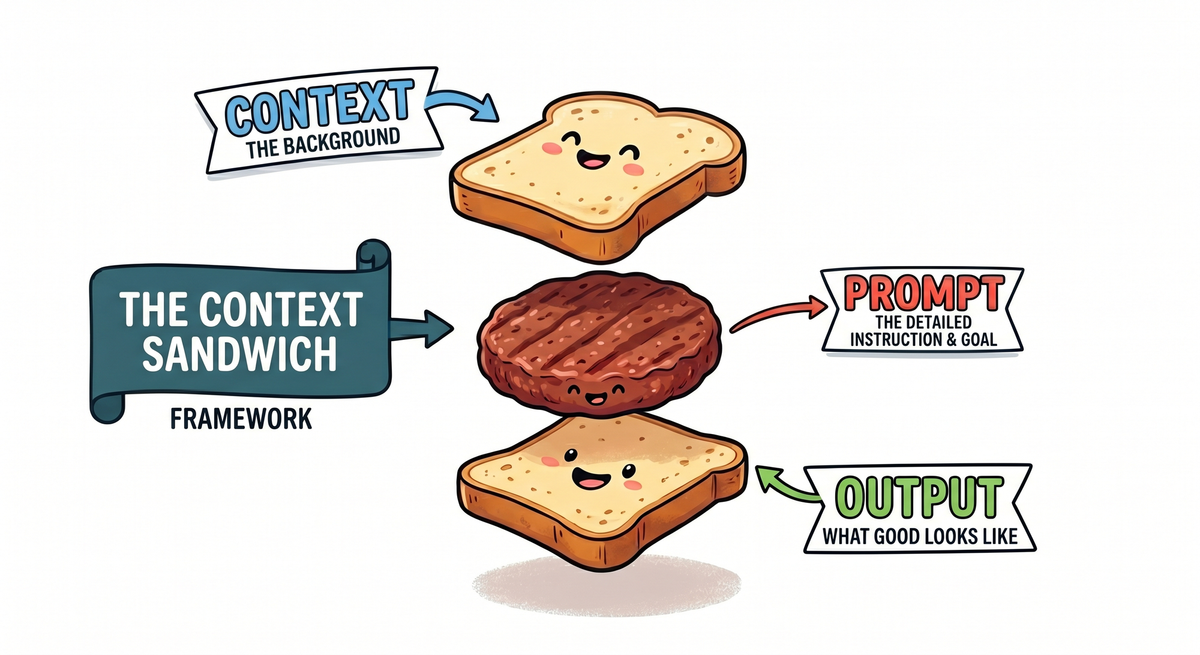
Net: giving AI context can make all the difference (but watch for bias and data leaks).
Imagine texting a new friend: “Lets grab a bite together tonight.”That’s it. Nothing else.
Your friend, meaning well, picks something they think you'll like. Maybe it’s fine. Maybe it’s Thai food in a lively, bustling setting...but you were craving something quiet and Italian. Or maybe they grab a table at a burger joint...but you are a vegetarian. You got food. You didn’t get what you needed.
This is how many people use AI.
Let's run that back in a different way.
You're reaching out to an old friend this time. This is the kind of friend who has known you so long they can finish your sentences. They know you’ve had a brutal week. They know you’re trying to eat lighter. They know you’d rather talk than sit next to a speaker. They know you like to sit outside if the weather is nice. They suggest the little Italian place on the corner, the one with the good wine and the unhurried service. And you are in luck! There is a table open outside.
Same request. Completely different result. The difference isn’t the question — it’s the context.
Quick Example: From Word Salad to Something Helpful
Early in my work with AI, I asked Copilot (which I use for work) to help draft a standard operating procedure. I gave some context. I described the problem, what I was looking for, and hit send. What came back was technically correct, a smart-sounding word salad with no dressing: a tasteless generic grab bag of corporate speak I would not have sent to my worst enemy.
This was the equivalent of saying "Let's grab a bite tonight" to someone who doesn't know me.
So I tried again.
This time I gave it everything I had and could think of that might help: brand guidelines; examples of SOPs we’d written that had actually helped; detailed notes from my meetings with team members about related issues, and about the unique needs of our junior team members; detailed descriptions of our services and more importantly who we truly as as a company. I gave it enough that the AI understood not just the question on the table, but the whole web of pressures, priorities, and relationships surrounding it.
The SOP that came back wasn’t finished, but it was a huge improvement. It had our voice. It used our language. It understood our world. Editing and refining was needed but I was 80% there.
The prompt hadn’t changed. The context had changed everything. I now load my AI platforms with all kinds of contextual information. It is now nearly a digital twin of my practice and of my leadership style (warts and all!). The results have been outstanding. Outputs still need work. Refinement is--and always will be--necessary. I need to ask it to push back, to provide a contrary view.
But all this now starts with a higher quality, better resolution first draft.
The Framework
Here’s the "context sandwich" framework introduced to me by Igor Pogany, an AI educator, author of The Ultimate ChatGPT Prompt Book and the Head of AI Education for AI Advantage.
Think of every AI interaction as a sandwich. The prompt — your actual request — is the filling. But a filling without bread is just ingredients on a counter. What makes it a meal is what surrounds it.
The first slice: who you (your organization, your client, your partner, etc.) are/is
Your role, your organization, your values, your voice, the industry you work in, financials, brand guidelines, performance metrics, the clients you serve, the standards you’re held to. As much about a client, partner, friend, family member as you can (and are comfortable to) provide. Whatever is relevant to the core issue. The more the AI understands about you and your world, the less it has to infer — and the more useful it becomes.
The filling: what you need
The actual ask. Keep this clear and be specific. Most people are not clear enough in what they are asking for. Clarity is your work. Analysis and output is AI's work. Do your part.
The last slice: what good looks like
This is the piece most people skip entirely. What does success look like for this output? What’s the tone? The length? The format? Can you point to an example of something that hit the mark? Define the target before you ask anything to aim at it. And what is out of bounds, what should be left out?Context. Request. Success criteria. That’s what Pogany calls the "context sandwich".It sounds simple but the simplicity is deceptive. Building real context takes real work. You might be thinking "Work?! I thought AI was supposed to save me time?" An understandable reaction. To save time later, you need to invest time upfront. You'll need to sit down and articulate things about yourself and your organization that possibly you’ve never had to put into words before. That work pays for itself quickly.
Think of every AI interaction as a sandwich. The prompt — your actual request — is the filling. But a filling without bread is just ingredients on a counter. What makes it a meal is what surrounds it.
Two things for your next use of AI
First, before you type your next prompt, spend two minutes writing or talking with a good thought partner about what you really want and what good looks like.
Second — and this is the bigger investment with the bigger return — build a context document with relevant information. If it's a work thing, this is information about yourself and your organization. Your role. Your organization. Your voice. Your standards. The kinds of outputs you value and the ones you don’t. If it's a personal thing, maybe it's information about your personality, work background or medical or family history. Save it somewhere you can paste it quickly. Feed it to your AI tool at the start of any serious work session.
You wouldn’t walk into an important meeting and expect a stranger to read your mind. Don’t ask your AI to either. Give it context. Be clear about what you want. Then go grab some Italian food with a friend. After all, if AI isn't giving us back some time to spend with loved ones--what's the point?
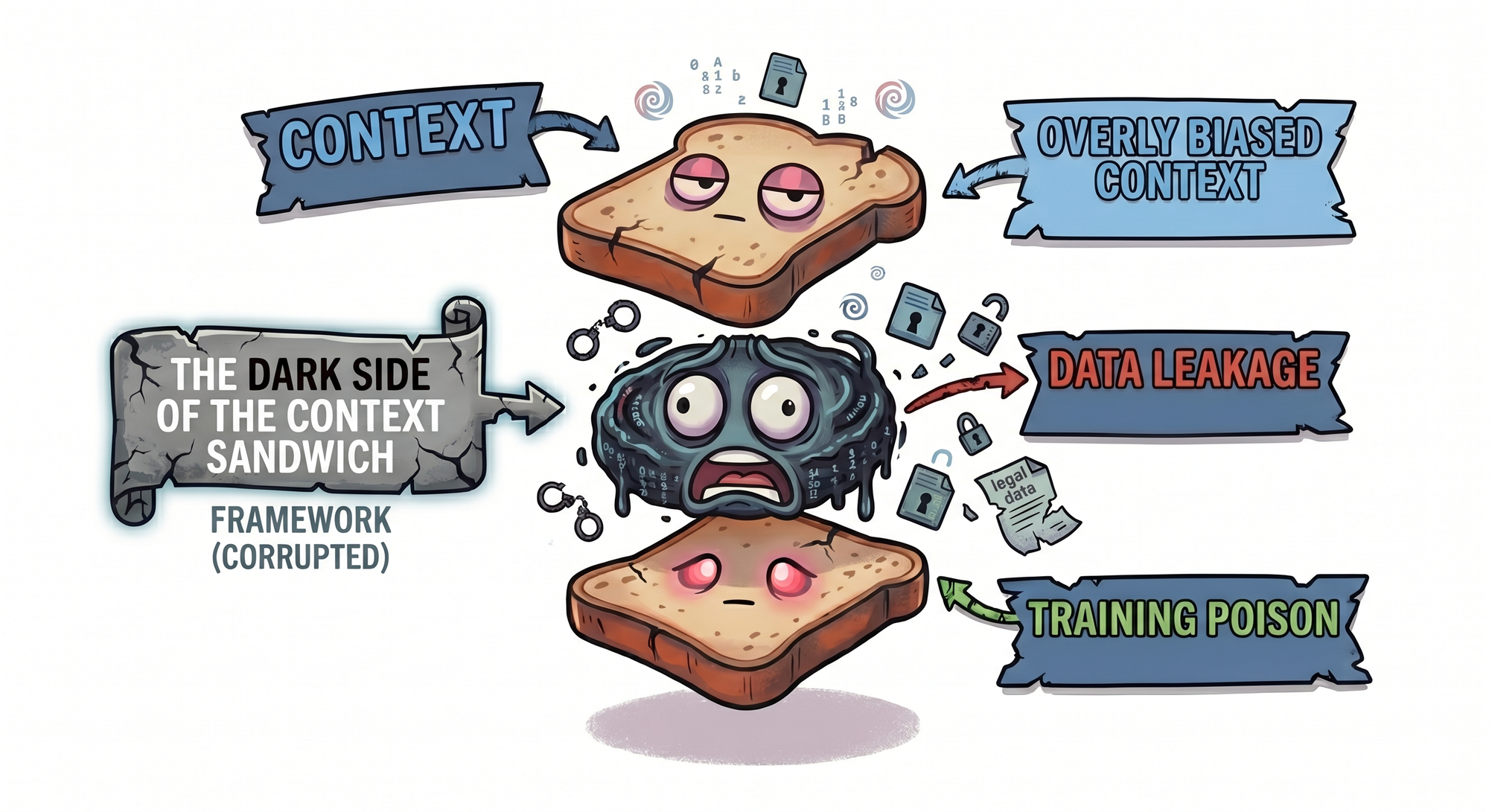
User Warnings: Context can constrain thinking and leak vital information
Context as Echo Chamber
By providing context you are providing bias. You must understand this basic truth and how the AI will use the information. Most AI's are sycophantic (programmed to please you and make you feel good). After all, commercial metric for AI is the same as for social media: engagement. It's about daily/monthly active users (DAU/MAU) tracking. This means the more time you spend on the platform the better. Humans spend more time where they feel valued, seen, encouraged, etc.
An AI will take context as the fence line within which to gather, analyze and report back. This is the whole point of providing context: more precision. It is also the constraint: an guilded echo chamber of your own making.
The solution: first, leave the "sandwich" open enough so that the AI has room to surprise you and challenge your assumptions; second, never ever surrender your responsibility to review and curate.
Context as Data Leak
By providing context, you could be providing legally protected information.First, let’s clear up a major misconception right out of the gate: what you type into an AI is not instantly posted on, or accessible from, the web for the world to see. Your chats stay behind your login.The real question is whether the AI company uses your prompt to train its future models. The answer comes down to your account type:
- Free/Consumer Accounts: By default, these platforms use your data to learn. You can easily fix this by going into your settings and turning off chat history and training.
- Work/Enterprise Accounts: If you are using a paid corporate tier, your data is contractually locked down. It is strictly isolated to your organization and is never used for training.
AI Needs Context Not Exact Identities--and Definitely Not Legally Protected Information
To get the best out of AI, you need to feed it context. But it needs mostly the logic of your situation, not the exact identities.
DO: Give the AI the background it needs to understand your role / company, the problem, and what "good" looks like.
DON'T: Never put proprietary, legally protected, or highly personal details into a standard consumer AI. This includes:
- Names: Real names of clients, colleagues, family members, or specific company names.
- Financials/Legal: Exact revenue numbers, legal cases, or internal financial records.
- Credentials: Passwords, account details, or government IDs.
If you are handling truly confidential corporate work, skip the free tools entirely and stick strictly to your company's secure, enterprise-approved platform.