Dumber by the Hour: How Back-to-Back Meetings are Killing Your Company (and what to do about it)
Like you, I recently survived a Tuesday that was less a workday and more a high-stakes clinical test of cognitive overload. What are we doing to ourselves?
My calendar was a solid, unyielding block of 10 meetings. Time management? You would think I'd never heard of it. David Allen would be appalled; Stephen Covey disgusted. Michael Hyatt would be shaking his head and Tim Ferriss, a single tear streaking down his cheek, would be forced to watch as I drove myself into oblivion, getting dumber by the hour.
To the "grind" culture, this looks like peak productivity. Meanwhile, our most expensive asset—our collective intelligence—is being liquidated in 30-minute increments.
Despite time-saving devices, add-ins and AI-agents, we have less time than ever before. In the U.S., we are hearing about a Strategic Petroleum Reserve for when the world is running out of oil. What about a Strategic Time Reserve for when the world is running out of time?
Alas, as the famous "Acres of Diamonds" parable has reminded audiences for decades: this Strategic Time Reserve is right under our noses. We can make difference choices about our use of time. We can get smarter rather than dumber by the hour.
The Neuroscience of Spreading Yourself Thin
At my current pace--and I'm not alone–there will be 40-50 meetings a week, 200 a month, and roughly 2,400 per year. The simple truth: the quality of the relationships, the thinking and the decisions from these meetings don't just determine the future of the company, they ARE the company. What else would your organization be than the result of the decisions you make? Therefore, the quality of these decisions is everything.
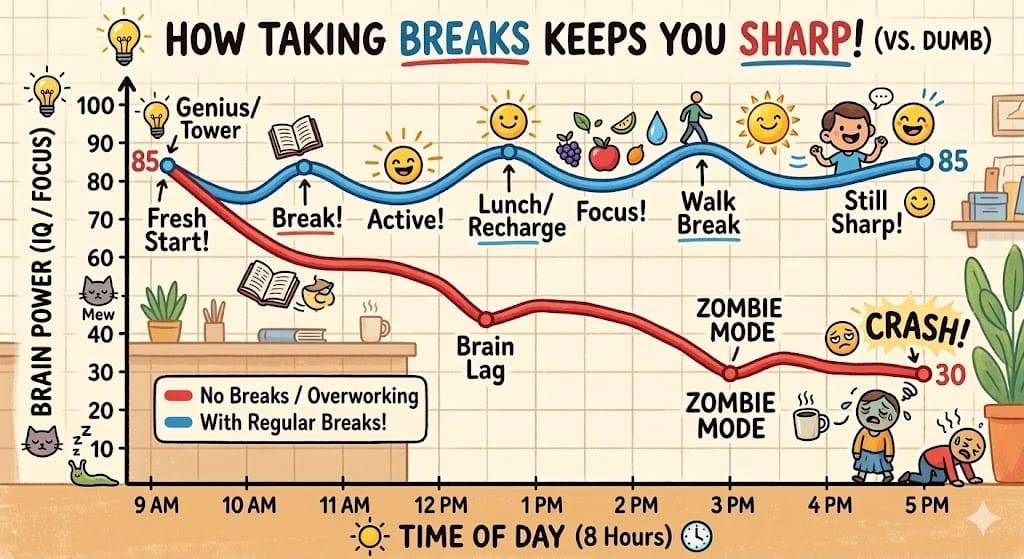
If we are getting dumber by the hour, there is a downward sloping curve of decision-quality.
Our brains are not appliances we can simply leave "on". They are biological systems with finite capacity for what neuroscientists call "executive function"--and what I call "thinking clearly." When we jump from a budget review to a creative brainstorm to a one-on-one to a staff meeting to a webinar with zero buffer, we encounter what researchers call attention residue.
Yes, you are leaving a streak of attention residue across your calendar, literally spreading yourself thin. As Sophie Leroy’s research indicates, your brain’s executive function continues to process the cognitive rules and unresolved threads of "Meeting A" while you are attempting to load the context for "Meeting B". This isn't just a "feeling" of being scattered; it is a literal switching cost that depletes your ability to think. In short, we get dumber as the day goes on.
Some more bad news that confirms what you already know: your back-to-back meetings are killing you...well maybe not, that but they are making you (and me) less effective as the day goes on.
- Allostatic Load: Chronic oversight and lack of recovery don't just stress us; they create an allostatic load—a wear and tear on the prefrontal cortex that impairs our ability to weigh risks or think strategically.
- Hypoglycemic Decision-Making: Similar to the "hungry judge" effect, our ability to make fair, nuanced decisions evaporates as the day progresses. By 4:30 PM, the probability of error in a multi-million dollar decision increases we slip into what is called "ego depletion".
- TPN vs. DMN: We spend our entire day in the Task-Positive Network (TPN)—the "doing" mode. But synthesis and complex problem-solving require the Default Mode Network (DMN), which only activates during periods of silence or low-intensity activity.
The Case for System Synthesis Time
I reach the end of these meeting days feeling like crap: headaches, feeling sick, blurry eyed and brain fogged. My wife avoids me, our cat hides and I swear the neighbors pull their blinds shut when I walk past, squinting at the sun like a prisoner emerging from solitary confinement.
This is the check engine light blazing on the dashboard. This is your internal computer telling you to reboot. When you ignore your kids they pester you. When you ignore your own wellness, your better angels are knocking at the door--and they'll kick it down if they have to.
When you ignore your own wellness, your better angels are knocking at the door--and they'll kick it down if they have to.
Stepping away—a 10-minute walk outside, 5 minutes of targeted exercise, or putting in a load of laundry—isn't "self-care" in the soft sense. It is a neurological reset that just may save your company.
Here's the truth: overloading your brain is putting your decisions and therefore your company at risk. Keeping the mind fresh and clear despite circumstances could be the defining leadership quality of our age.
Keeping Fresh and Clear: Getting Smarter by the Hour
To maintain a critical, professional edge, we must move past calendar Tetris and treat our schedules as an investment portfolio.
Field Notes on Dumbing Down
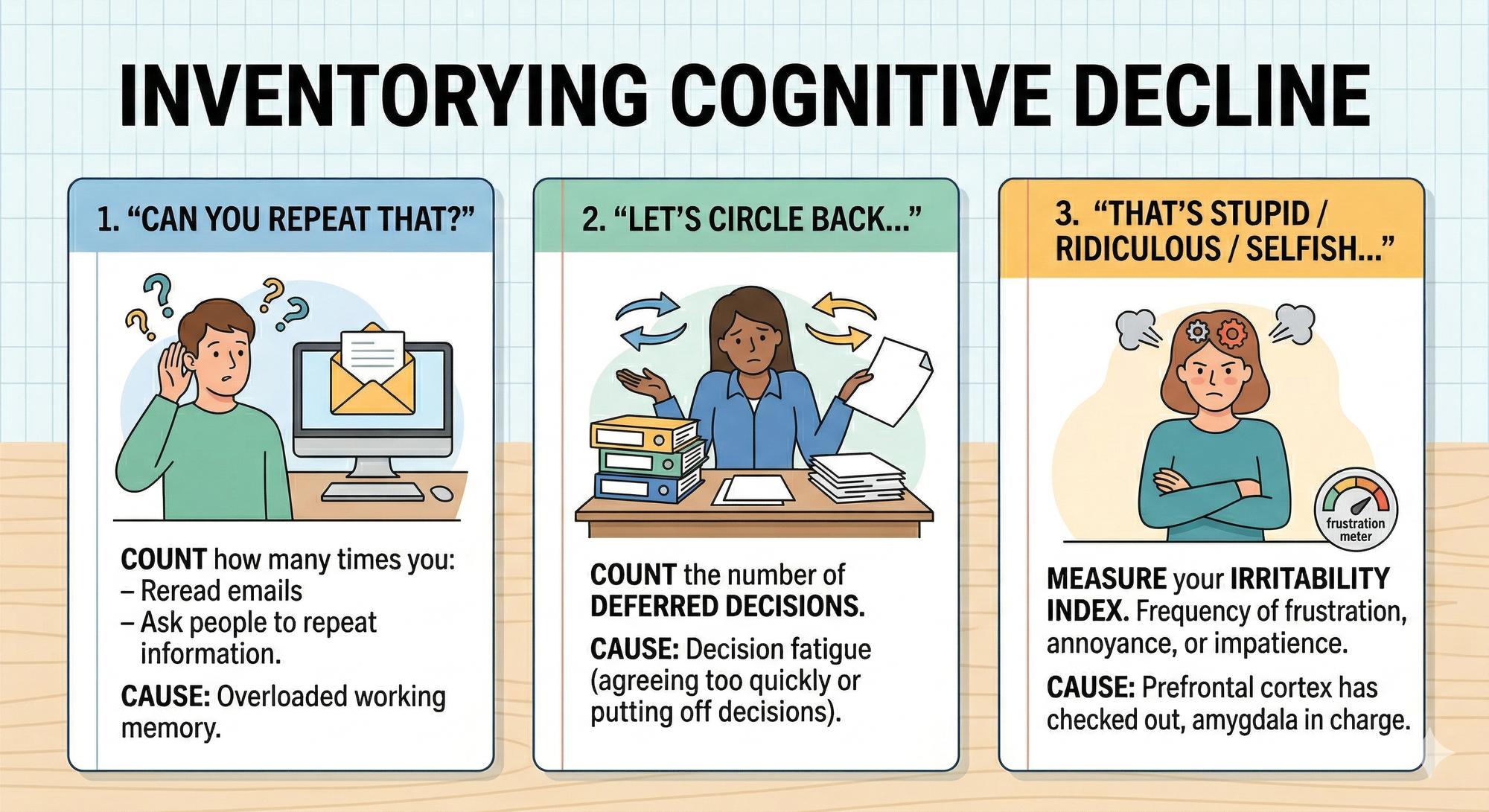
First, get some data. Grab a sticky note, journal or open up a dedicated notes document on your computer. Inventory cognitive decline by taking notes on the following factors:
- "Can you repeat that?" Count how many times you have to reread an email or ask people to repeat information. Working memory is the first things to go when the brain gets overloaded.
- "Let's circle back..." Count the number of deferred decisions. As decision fatigue sets in, you will see yourself either agreeing with others too quickly or wanting to put off decisions until later.
- "That's stupid/ridiculous/selfish..." Measure your irritability index: the number of times you get frustrated, annoyed or impatient with yourself or a colleague. This is a sign your prefrontal cortex has checked out, leaving your amygdala in charge.
Design Your Day
Use this data to craft a new day and a new week. What types of meetings exact the greatest demand on your brain? When during the day do you see the greatest cognitive issues? Some tips to consider to make this stick.
- Commit and Communicate: tell your team, boss, assistant, partner, kids, and anyone else that you are making a change (pre-commitment is linked with positive habit formation) and ask for their support (accountability partners are good plus this way they won't torpedo your new system)
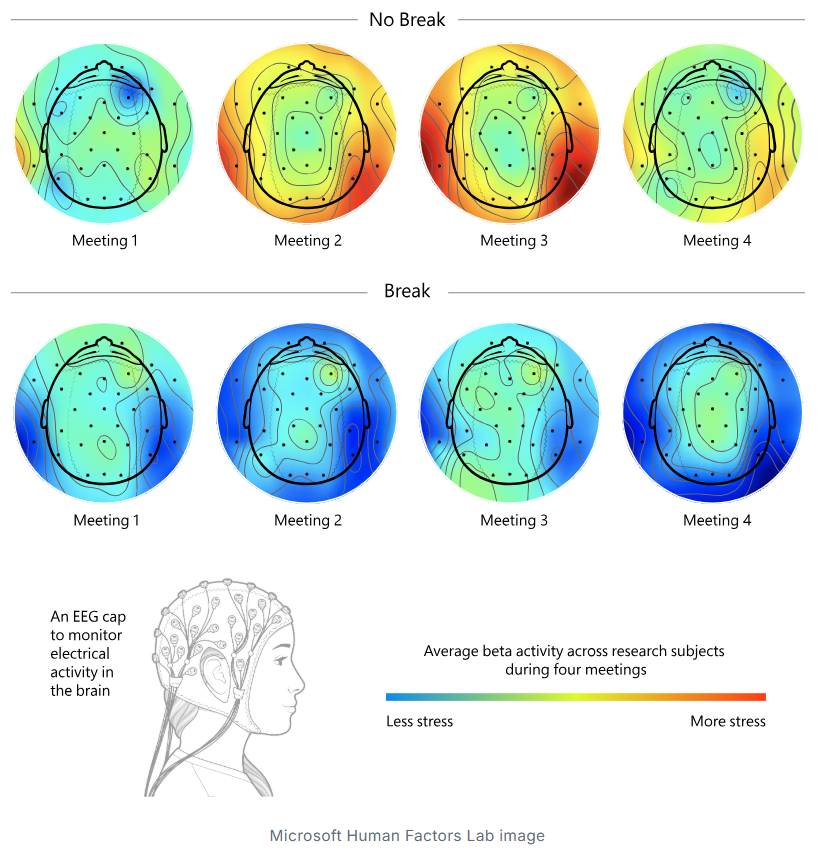
- Space Between Meetings Makes You Smarter: According to Microsoft Human Factors Lab research, space between meetings is essential. This isn't wasted time; it is the necessary period for the brain to convert information into usable intelligence. They studied the brains of people taking no breaks vs. people taking breaks between meeetings and found: "Breaks between meetings allow the brain to 'reset,' reducing a cumulative buildup of stress across meetings."
Closing Warning: Loving Stress More Than Peace
If we are getting dumber by the hour, why don't we feel it and make adjustments more quickly? Neuroscience explains that essentially we like the "high" of busy-ness more than the "low" (the ease) of mental stability. The truth is that, when you push through 6 - 8 hours of back-to-back meetings, your body triggers the Hypothalamic-Pituitary-Adrenal (HPA) axis, flooding the system with cortisol and adrenaline. This feels good to us.
The adrenaline narrows your focus, hides your exhaustion, and makes you feel "dialed in." What's more, the most busy and the least available appear to be the most important. Packed schedules are a proxy for status. In reality, this stress-induced focus soon fades, the constant vigilence is unsustainable and the brain powers down.
The truth is that, when you push through 6 - 8 hours of back-to-back meetings, your body triggers the Hypothalamic-Pituitary-Adrenal (HPA) axis, flooding the system with cortisol and adrenaline. This feels good to us.
According to Harvard Business Review, AI can exacerbate this state of "brain fry" leading to a 33% spike in decision fatigue. A 2018 Gartner study referened by HBR suggested the cost of "suboptimal decision making" for a $5B revenue firm at $150M per year. In short, you aren't powering through; you are going into cognitive debt.
The Bottom Line
A break is not a sign of weakness or a "nice-to-have." It is a neurological requirement to clear the stress residue that is quite literally making you—and your company—dumber by the hour. Stop trusting the adrenaline; start trusting the feeling of mental stability.
As we protect our cognitive and emotional capacities, respecting limits not as barriers but as assets, we safeguard the not-so-secret sauce of every company: the quality of its thinking and clarity of its actions.